October 2025


TSER vs IRR: which spec is best?
A supplier’s mission is to sell film to installers. An installer’s mission is to sell film to the end user. At every step, the performance of the film must be promoted accurately, verifiably and in a way that is easily understood. The legal and moral onus is on the supplier and installer to never mislead their customer when selling film. For this reason, WFAANZ encourages the use of TSER (total solar energy rejection) when discussing heat rejection and not IRR (infrared rejection).

TSER describes the solar energy that’s rejected from passing through glass. It is expressed as a percentage, so the higher the percentage the more heat that’s blocked (the opposite of SHGC).
The reason TSER is more accurate than IRR when talking heat rejection is that it considers all three forms of solar energy – infrared (IR), visible light and UV. It tells the full heat rejection story.
IR values by themselves can be misleading because:
- Film suppliers calculate them differently so you can’t compare apples to apples
- IR is not the only form of heat, visible light can bring heat too. Therefore, IR values only represent a portion of the heat being rejected
WFAANZ advice to installers wanting to compare the heat rejection performance of films from different suppliers: compare the TSER of films with the same visible light transmission (VLT).
TSER CALCULATION
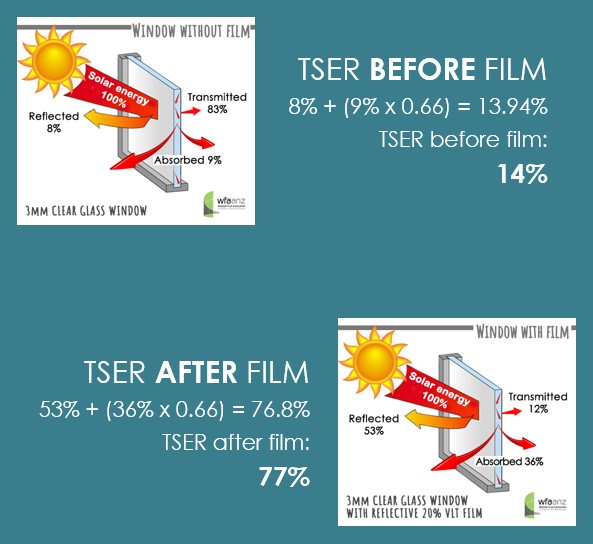
- TSER = reflected energy + absorbed energy that is *externally reradiated
- *Externally reradiated energy is absorbed into the glass and then reradiated to the outside
- As a rule of thumb, around two thirds is reradiated externally and one third internally due to external convection, so when calculating TSER we assume 66% of absorbed energy is reradiated externally and 34% is reradiated internally
This slide (right) is from the WFAANZ Architectural Window Film Certification workshop. Read more about the next training session below.
Flat glass film training – get involved
The next WFAANZ training session is open for registration. To be held online on Wednesday, 29 October from 10am to 1.30 (EST), it is a live Teams Meeting session followed by an online exam. Suited for all experience levels – those tinting for years or new to the industry – it builds solid knowledge about the technical aspects of flat glass film and provides WFAANZ certification for a competitive edge.
For more information or to register interest, please contact info@wfaanz.org.au or download an enrolment from here.
Anyone who passed the WFAANZ Flat Glass Exam prior to 2023 can attend the workshop for free as a ‘refresher’ as there is so much new content in the training.


Clear facts about tinting windscreens
Recent debate on tinter forums about whether clear film on windscreens is legal in Queensland prompted WFAANZ to reach out to the QLD Department of Transport & Main Roads.
Ally Cronan, WFAANZ President, comments, “Some people interpreted the word ‘tint’ to mean that an optically clear film was allowed. While we knew this wasn’t the case, WFAANZ still sought clarification from the Department to avoid further confusion.”

The reply below is from a Senior Advisor (Vehicle Standards) at the Policy, Planning & Investment Division of the Department of Transport and Main Roads, Queensland.
“In simple terms, tinting a windscreen is illegal, not including the tint band at the top of the screen up to 10% of the depth of the windscreen or upper edge of the wiper sweep. The intent of this legislation is to maintain the windscreen clarity through the primary vision area. Tinting a windscreen increases visibility risk at night and in inclement weather. From a technical point of view, no film may be applied that reduces luminous transmittance (LT).”
That last sentence is reflected in the legislative language of every jurisdiction, in that no film (coating) can be applied to the windscreen that lowers its LT.
All films, even clear films, reduce the LT to some degree and therefore all films, even clear films, are illegal on the windscreens of light vehicles in QLD at this time. This rule stands even if the glass + film VLT is well within the 70% VLT requirement. WFAANZ will let our members know if this changes.
Australia’s Complete Film Solutions dubbed world champion…again.
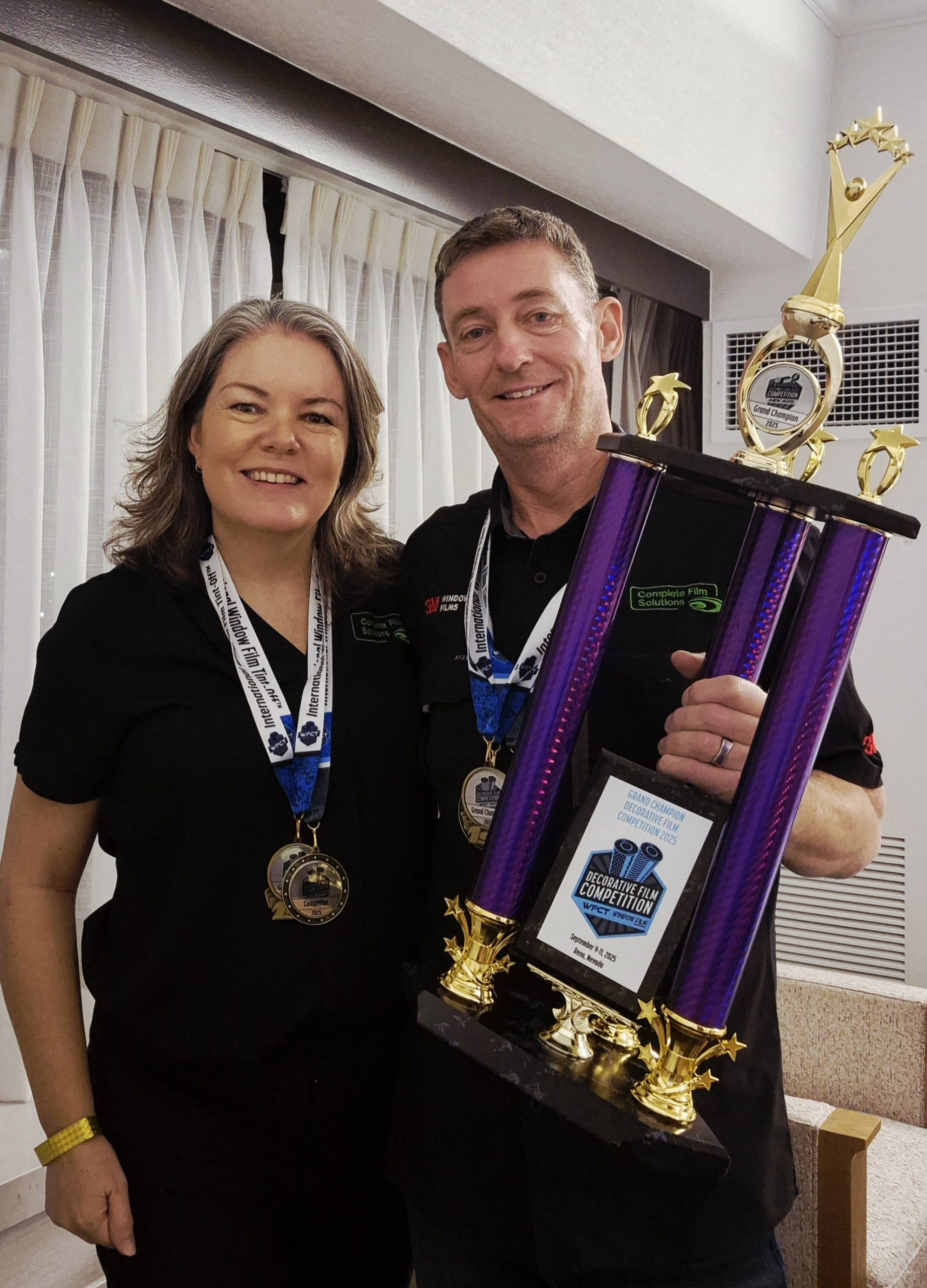
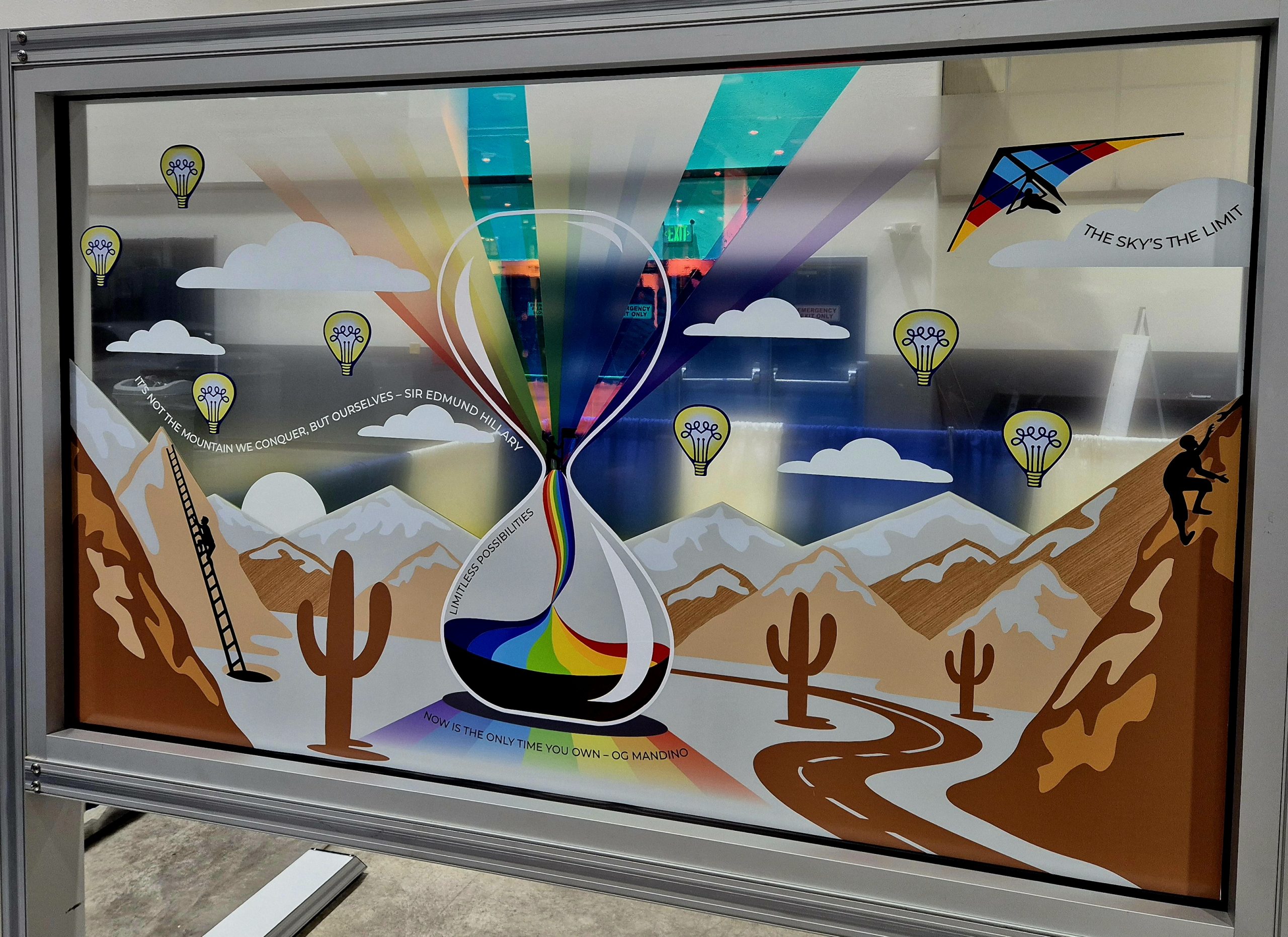
If you were given the theme “Between Peaks and Possibilities” what design would you create to compete in the Decorative Window Film division at this year’s Window Film Conference & Tint Off (WFCT) in Reno, Nevada? In October, the Aussie team from Complete Film Solutions in WA designed and installed an impactful and clever display that won them the coveted trophy.
On competition day, installers Brent and Chris Caithness worked together to bring their Graphic Designer Gayle Marshall’s vision to life. It’s the third time they’ve been on the dais, winning the same division in 2022 and receiving People’s Choice in 2024.
As well as a lifetime of bragging rights, the first prize for Decorative Film was $20,000 USD, a massive trophy and gold medals for each team member.
Three hours is allocated to complete the install in front of live spectators. Teams can have up to four installers, but Brent and Chris have always competed as two-person force.
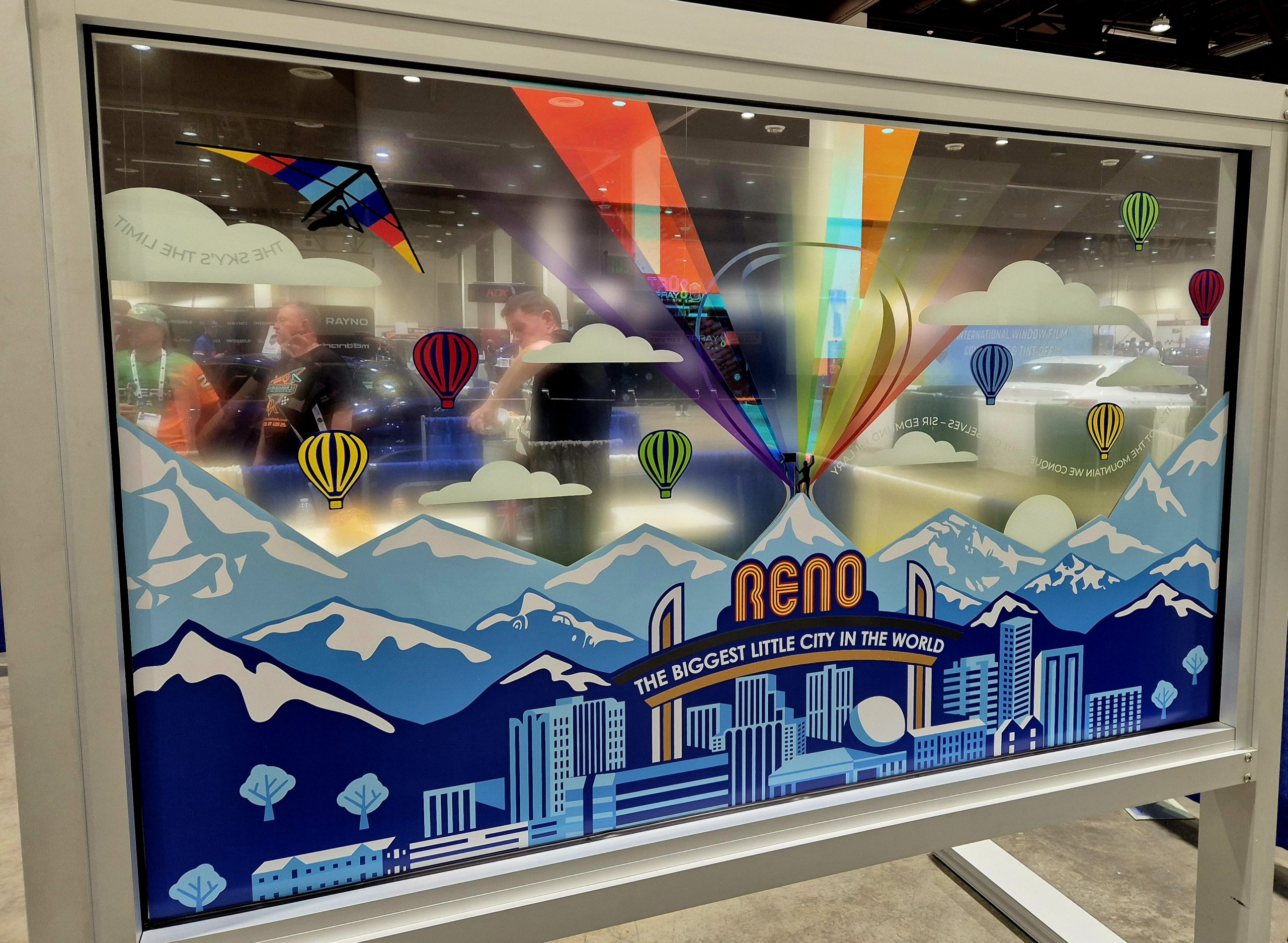
Brent comments, “We absolutely used the three hours. We had laid up more of the design at home so there was less time pressure than past years, but we still used the full time. The only hurdle was that the pre-laid up Dichroic had some drying marks, but that was the only real concern. Everything went quite smoothly.”
The hardest part of the process? Waiting for the results to come in. The install was completed on day one, but results weren’t announced until day three at the Awards Dinner.
Brent adds, “Our confidence waxed and waned during the waiting period. It’s hard to compare ours to others as we are too close to it, and we never know which way the judging will go. It was a lovely surprise when our names were called out.”
Brent and Chris are calling out their fellow Trans-Tasman tinters to join them next year.
“We’d love to see a LOT more Aussies and Kiwis attend in ‘26, which is looking like it’ll be in San Antonio, Texas. It’s worthwhile, great fun, and yes it costs a bit to attend but it’s a work-related tax deduction.”
The event runs competitions in flat glass, auto glass, decorative, PPF and vinyl wrapping. This year the winner of the automotive tinting division, the biggest event, was gifted $40,000 USD.
Words of advice for tinters thinking of attending?
Chris Caithness said, “Book the tickets and go. As well as the comp there’s education sessions, social events and trade show exhibits to keep you busy. Push yourself out of your comfort zone and see how you cope under pressure. If you’re looking to compete in Decorative, start keeping photos of your decorative film installs, so you can pull together your portfolio submission easily.”
Their only problem now…finding a spot for their gargantuan trophies.
NZ suppliers’ warn of the dangers of sub-standard imports
Bit of advice for anyone chatting to Ross Eathorne, Solar Gard NZ, or Wayne Anstis, MEP NZ – don’t mention imports. The topic grinds their gears. They both agree, at present, the proliferation of poor quality, untested imported films pose one of the biggest threats to the NZ window film industry. A rundown of the situation in their own words…
Ross Eathorne, Solar Gard NZ
“The increasing amount of unverified imported film appearing in the NZ market that’s being passed off as quality product and installed by people who don’t know what they’re doing is decimating the reputation of our industry.
I’m even witnessing auto film being installed into domestic residences.
A concern I have this Summer – how many ticking time bombs are out there where incorrect film has been installed on an IGU with a Low E coating on surface three? As soon as the temperature increases, the glass is going to break. The installer isn’t affected or blamed as they will have disappeared. Rather, it’s our entire industry that takes the hit.
It’s getting to the point of irreversible damage to our market. I accept that ours is an unregulated market, so policing this activity is near impossible. That’s why I’m so invested in WFAANZ, as we need to enact industry-accepted visual quality guidelines and for there to be a peak industry body that represents and defends industry standards. I also support an education program run by the association on the merits of having quality, verified window film.
The strength of the association in NZ entirely depends on its membership. We need more NZ members to join WFAANZ – all the smart operators out there who I deal with every day, with experience, who take pride in their work, who abide by a code of ethics and the laws of the land, who are in it for long haul. The way forward is to make it as hard as possible for the cowboy tinters installing unverified film to get jobs.”
Wayne Anstis, MEP Films:
“Unfortunately, I too am seeing a lot of new installers with little to no experience and little to no thought for what they’re installing or the consequences of installing sub-standard film.
There will be fallout for our industry, particularly with the new standard of double glazing now having to meet a high standard of compliance.
Unprofessional installers who are even warned by their competitors NOT to install certain films on DGUs, but do it anyway for a quick buck.
We are trying to educate installers to make it a point of difference where they come across these types of businesses during quoting, to point out the danger and risk to the end user.
I see it as the role of WFAANZ to provide the foundations of this education campaign, and to create tools that help installers pass these messages on to their customers.
End users are usually unaware that they’re voiding the warranty on their DGU’s or the liability and potential damage to existing glazing using poor quality products.
An old adage that applies here: The bitterness and consequence of poor quality is remembered long after the seduction of a cheap price’”
Vale Peter Wotton
In August WFAANZ learnt the sad news of the passing of an industry great, Peter Wotton. A founding member of WFAANZ, Peter was a legend in the window film industry whose impact will be felt for years to come.
Solar Gard Australia Managing Director from 1997 to 2008, and a decade plus with 3M prior to that, Peter was well known, highly respected and much loved.
Our sincere condolences to Peter’s family.
Rob Hamilton: “So many of us have fond memories of Peter, even those of us with memories discussing politics where he had so much passion and couldn’t be swayed in his beliefs! You were forever the kind and respectful gentleman and may you rest in peace mate.”
Prominent religious school in Melbourne bolsters staff and student safety with security film for blast mitigation
Just shy of 1000m2 of security film and almost 3km worth of caulking was recently installed over four campuses of a prominent religious school in Melbourne’s inner suburbs for blast mitigation.
According to Scott Tepper, tint.melbourne, the mammoth job involved removal of existing silicone, security film installation and the application of structural silicone – entirely outside of school hours. An international third-party security firm had to sign off on tint.melbourne, the film and the structural silicone following Scott’s recommendations.
Making glass visible…and cool
Manifestations don’t have to boring.
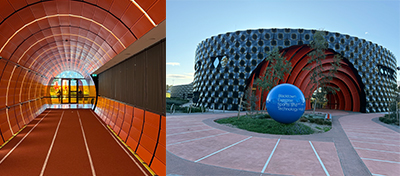
Just ask the Blacktown Exercise Sports & Technology Hub, which used a 1500mm orange band to make this glass door as distinctive as the rest of the futuristic building. Thanks to TintFX for the pic.
Condensation cures
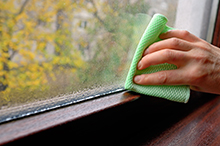
Window condensation, the bugbear of many a home owner. Causes include different temperatures on each side of the glass (which is why it’s common in the morning as the sun first hits the window), high humidity and/or poor window quality. Ideas for controlling it: dehumidifiers and fans, a smaller HVAC (so as not to cool too quickly), and interestingly, removing firewood and plants from the room as both can release moisture into the air.
Did you know…
Of the UV that reaches the Earth’s surface, 95% is UVA and 5% UVB*. While glass prevents most of the UVB from penetrating a building or vehicle, window film can be applied to block UVA. And for those who still think UVA isn’t as harmful because it doesn’t cause skin cancer – in 2009, the International Agency for Research on Cancer (IARC) classified the full UV radiation spectrum as carcinogenic to humans*. Source: *Cancer Council

Tractors and tint
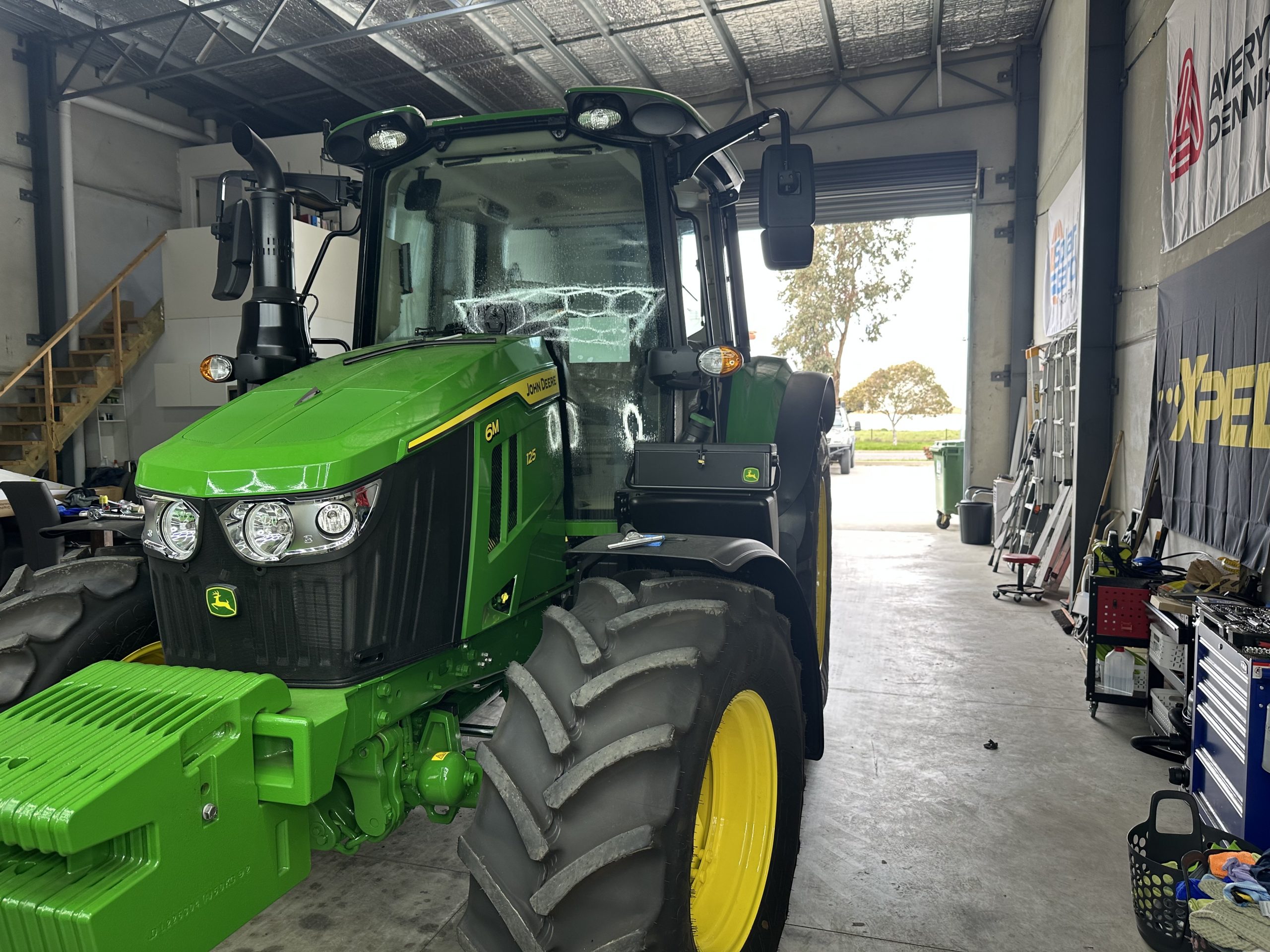
If a tractor drives on public roads, it must comply with the same glazing and visibility standards as other vehicles – which means no window film on the greater part of the windscreen, no matter the VLT of the film. No special exemptions for tinted windscreens are outlined even for agricultural vehicles.
But if the tractor is only used on private property (e.g. farmland, paddocks), it may not be subject to public road vehicle standards. In these cases, clear or UV-protective films that don’t reduce VLT can help protect the driver.
Thanks to Austint in Victoria for this picture. Austint recently finished four tractors with ceramic film and windscreen protection film.
FEATURE
Tool up
Precision and experience, two traits all the skilled tinters have in spades. The other common denominator – the right tools. In many cases, when something goes wrong with a film job the installer’s technique isn’t to blame, it’s more to do with the film or tools.
Here, we go through some of the many options for buying tools available to tinters.
Dedicated online shopfronts
Two of the newer players to the tint tools market are Tint, Sign, Wrap Tools, based in Sydney and run by Aaron McCarthy, and Tint Tools, based in Perth and run by Mal Cruikshank – both long standing WFAANZ members.
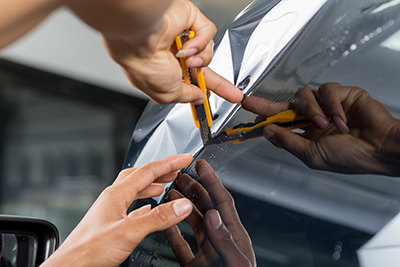
Aaron McCarthy, Tint, Sign, Wrap Tools
Why did you start the business?
While I’ve been a tinter for over 30 years, Tint, Sign, Wrap Tools is relatively new, only launching in April this year. We offer a comprehensive selection of Fusion Tools. Fusion have been around for over 20 years in the USA. I’ve been using them since I first came across them over ten years ago.
As a tinter, which tool is your favourite?
That’s hard as there are favourites in each category. I have had to choose one it would be the magnet application tool for PPF and vehicle wrapping.
Any tools have dual purpose people may not know about?
The Red Glass Saver was designed for removing paint specks, but I use it for cutting the edge of the film. It is strong and ridged and allows you to get closer to the rubbers
Any trends in the industry reflected in the sales of tools?
Stretch handles – they reduce fatigue, make for a more professional install and in a shorter time frame
Mal Cruikshank, Tint Tools
Why did you start the business?
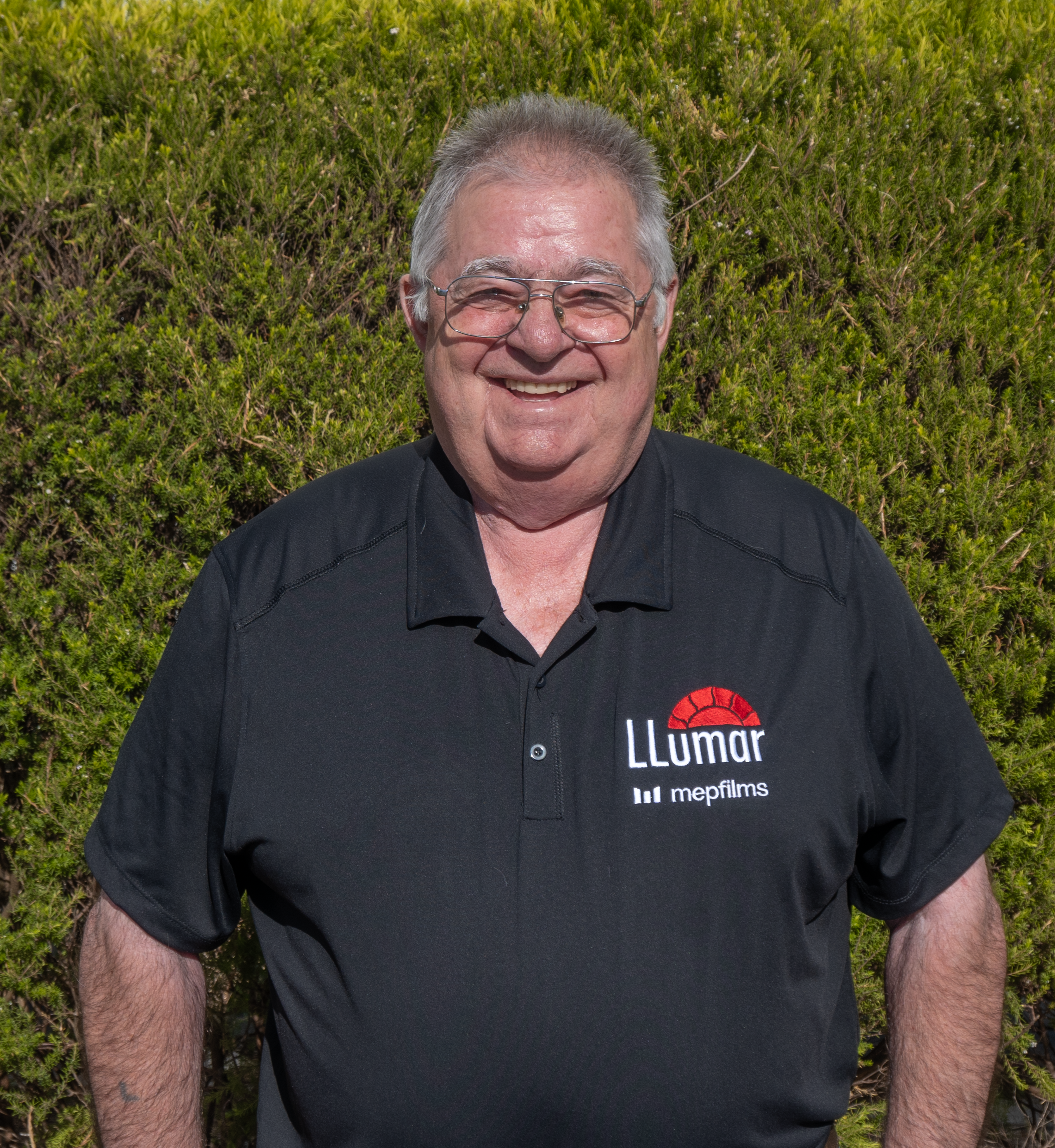
Tint Tools is an online shop for tools solutions and consumables we use in the film industry. It’s part of WindowFilms WA, a business that has been evolving since1998, when I put down my squeegee after tinting for 10 years and got involved in the distribution side of the industry. Our philosophy is that we want to make tinter’s life easy by stocking what they need so they don’t have to search everywhere. It’s a wide range of tools from all over the world and brands like Unger, Triumph, Olfa, 3M and Fusion.
As a tinter, which tool is your favourite?
I think your best friend has to be the Blue Power Strip in the squeegees to remove the moisture under the film. Nearly all the excess mounting solution is removed, especially when using a sputtered film. These strips give you four new corners to work with every time you replace it and it comes in rolls up to 3 meters. It has to be one of the most efficient and economical ways of doing it.
Any tools have dual purpose people may not know about?
PODS pressure on demand steamers are really popular with good PPF installers. They make the installation easier and faster. We have been using steam to remove tint, vinyl and PPF for a long time. I also use my Pod to clean almost anything that isn’t electrical.
Any trends in the industry reflected in the sales of tools?
Everything has changed since the PPF has become more mainstream. We are seeing convergence of tools that are suitable for solar films, PPF and vinyl wrapping. New hybrid squeegee blades and spear cards that have a variation of flexibility and slip and becoming more prolific.
WFAANZ distributors
Many of Australia’s top film suppliers offer a range of tools well suited to the installation of their films.
Michael Miller, MEP, “We have a range that we intentionally keep simple. We stick to what either the film manufacturer recommends – which is always key and utmost importance – and other tools that we trial and know work.
“It may seem like an obvious point,” Michael adds, “…but tool maintenance is vital. They must be kept clean, sharp when necessary and updated when wear and tear is observed, and always follow the film manufacturer’s recommendations.”
Solar Gard NZ and MEP Films NZ also offer a range of tools well suited to the installation of their respective films. Installers can contact either supplier to discuss its range and offering.
PROFILE: John Daginis, from frige desk to industry legend
Earlier this year John Daginis retired from the Australian window film industry to enjoy some well deserved rest and relaxation. From the entire WFAANZ family, we thank you John for the time you dedicated to the association, and for generously sharing your wisdom, knowledge and boundless good humour with us over the years. This story is in John’s words…
In 1971- 72 I worked for a company who had a new product added to their business – window tinting. I was asked to be a tinter and was given a book to read on how to install window tint for flat glass – this was the only training I got.
In those days, we used a spray-on glue on the glass, and the only colour available was Silver Reflective Film.
3M were the first company to import film and three months later we started selling film. Over the years I worked for company using 3M, Madico, Bekaert /DTI and Sungard.
Eventually I learnt how to install auto tint. This was a challenge as you had to do overlap splicing on a rear screen. I remember once having to do 15 splices on a Porche. Eventually George Marriotto developed training lessons on how to install auto tint to a rear screen in one piece, this was the best thing since sliced bread.
I joined MEP in 1986 to train Sol-Ace on how to sell and install flat glass film.
I remember my office was a large cutting table and my desk was the top of a bar fridge – so I really started from the bottom. At MEP Films I decided to start teaching how to sell different products to all business via seminars in Sydney and country areas. MEP was very supportive of this successful program as companies were educated on all films.
I have many proud moments.
Back in 1992 we almost lost our industry. The NSW government banned auto tint and tried to close all tinting businesses, and the suppliers united to save the auto tint industry. WFAANZ was created after this, when we saw how much better it was to represent the industry as a unified body.
I thank the following people for this 3M Peter Wotten, Bekaert/DTI Jim Neeves, MEP George Mariotto, Madico Gary Lane and Sungard Richard Hall.
My involvement with WFAANZ was initially as Treasurer. I personally would like to thank all committee past and present on supporting this great industry. I would also like to thank WFAANZ for introducing WERS For Film training, which I completed and which I presented for a time. I encourage all flat lass tinters to do this professional training course and boost the professionalism of our industry.
In retirement I’ll miss the friendships I made over years from 1986 to 2025. To my colleagues, I will miss greatly thank you. I also thank John Sofarnos from MEP Films for taking us all to see how film is produced – it was an experience.
A funny experience was when a new product called ‘flow on liquid tint’ came on the market. Our boss came out dressed in a suit to show us how to install it. At one point, the hose came off and green die sprayed everywhere, over the white lush carpet and the walls. In a panic, the boss stuck the hose into his belly button. Let’s just say he was also green everywhere.
Now retirement! It is strange at first after spending 50 odd years working. I’ve got this year planned with trips to FIJI, Margret River, plenty of fishing, golf and looking at joining Marine Rescue. Just trying to be active and enjoy life. I’d like to thank Warren Koopmans for making my retirement memorable.
I wish all tinting businesses great success. I’m truly fortunate to be involved in this industry and watching it blossom over the years.
Can you please provide information on the application of safety film within a childcare facility? Could you please advise the minimum height for safety film application in AS 1288:2021 Glass in Buildings – selection and installation?
Window film provides an excellent option for building owners needing to increase the safety of their glass without the expense of glass replacement and AS 1288:2021 Glass in Buildings – selection and installation offers a great opportunity for window film installers.
Remember, we’re talking about safety and in many cases the safety of children, so AS 1288 must not be taken lightly… get a copy!
Window film installers cannot conduct glass safety audits for their clients. Only certified building inspector or engineers are qualified for this. It is important you advise the client you are offering your opinion on which glass you believe should be window filmed in accordance with AS 1288, but you are not qualified to provide a formal audit. It must remain the client’s responsibility to ensure compliance via a building inspector or engineer.
AS 1288:2021 Glass in Buildings – selection and installation nominates the types of glass that must be used in different areas of buildings and types of buildings. It is referenced in the National Construction Code (NCC).
AS 1288 covers many requirements such as the strength of balustrade glass, overhead glass, glass subject to wind loads, glass subject to human impact and much more, but the main area of concern to window film installers is human impact.
AS 1288, Section 5, Criteria for Human Impact ensures safety glass is used in locations at risk of human impact. These locations include doors, low level windows, shopfronts etc. AS 1288 also has specific sections dealing with glass in bathrooms, schools, aged care facilities, and childcare facilities. There is no ‘one size fits all’ approach when safety glass is required in any building.
Safety glass can be:
- Laminated glass
- Toughened/tempered glass
- Safety organic coated glass (annealed glass with safety film)
Annealed glass can be achieve Grade A safety glazing with safety window film.
There are maximum permissible pane sizes for different glass thicknesses. For example, a 3mm thickness pane may be safety filmed to attain Grade A status only if the pane is less than 2m2, if the pane is 6mm thickness then the pane can be up to 3m2, and so on.
When installing safety film for AS 1288 compliance consider the following:
- Each pane must be labelled as being a safety glass. Window film distributors must provide you with AS 2208 compliance stickers. These must be adhered to a corner of every pane, prior to the window film. Installing window film over the sticker ensures its permanency. These stickers must show the year of film installation.
- Some client’s may also ask you for a paper certificate of compliance. This is not an AS 1288 or AS 2208 requirement but WFAANZ distributor members will be able to provide you with this if required
- AS 1288 requires most glass within 1m of the floor to be Grade A safety glass. This means that if the bottom of the glass pane is within 1m of the floor then the whole pane must be filmed. Do not install a strip of film along the bottom of the pane to cover just the glass area that is within 1m of the floor
- AS 1288 has a section entitled ‘Making Glass Visible (Manifestation)’. The purpose of this requirement is to help avoid people walking into the glass because they can’t see it. This is common on glass doors, walls, etc. An opaque window film may be installed as a strip across the glass and this can also be computer cut with logos or decorations. Clause 5.19 covers what is permissible in detail. A word of caution, buildings where the BCA requires access for people with disabilities have different requirements for manifestation and these are detailed in AS 1428.1.
If an auto film’s specs says it has ‘99% UV rejection’, does that mean both UVA and UVB rays?
In general terms, auto glass blocks most of the UVB anyway so the figures from manufacturers/distributors relating to UV rejection cover both UVA and UVB.
As an independent association, WFAANZ can’t comment on film specifics – we don’t discuss/endorse/promote products. We also cannot speak to the calculation methods of different suppliers. On that front, WFAANZ recommends working with a WFAANZ distributor member (here) all of which have made a commitment to upholding industry standards and a code of ethics.
I was talking to a health specialist in Canada named Justine Stenger, and she claimed that according to Scott Zimmerman, some UV and some IR light has important health benefits and window glass without film disrupts this. They claim that some UV light is protective rather than detrimental for skin health. What is WFAANZ’ comment?
Some good points there about the positive benefits of sunlight to our health. For instance, a lack of sunlight leads to a vitamin D deficiency plus as you say there would be other benefits and certainly more being discovered.
Film has no impact in this sense as glass itself blocks the UVB, film does UVA. According to the Cancer Council, of the UV that reaches the Earth’s surface, 95% is UVA and 5% UVB.
Without having further detail about the wavelengths needed for the other health benefits that Justine and Scott refer to, it’s hard to speak to their views directly. Having the wavelengths in question identified is important because – like in the vitamin D example – those wavelengths may be outside of what window film acts on, making it a moot point.
The detrimental effects of passive and excessive exposure to UV must be considered when addressing this question.
Using the vitamin D example, the Cancer Council states: “For most people, adequate vitamin D levels are reached through regular incidental exposure to the sun. When the UV Index is 3 or above (such as during summer), most people maintain adequate vitamin D levels just by spending a few minutes outdoors on most days of the week.”
The health benefits we may miss by restricting UV and IR light must be weighed against the health risks of all day UVA exposure from unfilmed glass.
Problems arise when, through work or activity, you are exposed to sunlight behind a window. While someone may feel protected because they’re ‘inside’, driving a truck or sitting by an office window for example, they’re getting hours of direct exposure per day. Unfilmed glass transmits a lot of UVA (which can be a health concern), so that driver or worker is at risk without them realising.
Thanks to campaigns like slip, slop, slap, when people venture outside they are aware that a risk exists under the sun, and more likely to take steps to prevent burn and limit the duration of exposure. It is our estimation that most people aren’t as conscious of the UVA risks of sitting behind vehicle or building glass.
Welcome new members
 Complete Film Solutions, WA Refined Tinting, NSWPlatinum Tint Solutions, NSW

Important piece of the puzzle
Promoting your WFAANZ membership should not be the entirety of your marketing plan. But it should definitely be a part of the puzzle if you want to squeeze every last bit of value out of your membership.
When you join WFAANZ you get a marketing email from me, Ally Cronan, with some marketing advice. Included is a blurb to explain to your customers why your membership matters.
This is just a reminder that if you haven’t done things like include the blurb on your website, plastered the WFAANZ logo on your materials, offered fact sheets to your customers or shared our social media content – you may not be getting all you can from your membership. Contact ally@acpublicrelations.com.au for more info.