
March 2026



Know the glass, avoid the coat
Rising popularity of Low E glazing has exposed something tinters have known for years – just because a window costs a bomb and surpasses energy requirements doesn’t mean it offers thermal results every time.
Why can a window’s energy performance look great on paper but not deliver in reality?
A basic misunderstanding of Low E could be a factor, poses WFAANZ President Ally Cronan.

“Low E coats do not reject all types of heat equally,” Ally says. “While Low E effectively blocks far infrared – such as heat radiating from concrete driveways or structures – it does not work nearly as well on solar heat rejection. So, when Low E glass is specified in locations that get hammered by the sun the performance can be underwhelming.”
This ABC News article goes so far as to dub large windows a ‘design flaw’ in modern Australian apartments due to heat load.
Ally adds, “There continues to be increased interest in tint from people with new windows who experience too much heat. And when these windows cost thousands, a solid understanding of which film should go where is crucial.”
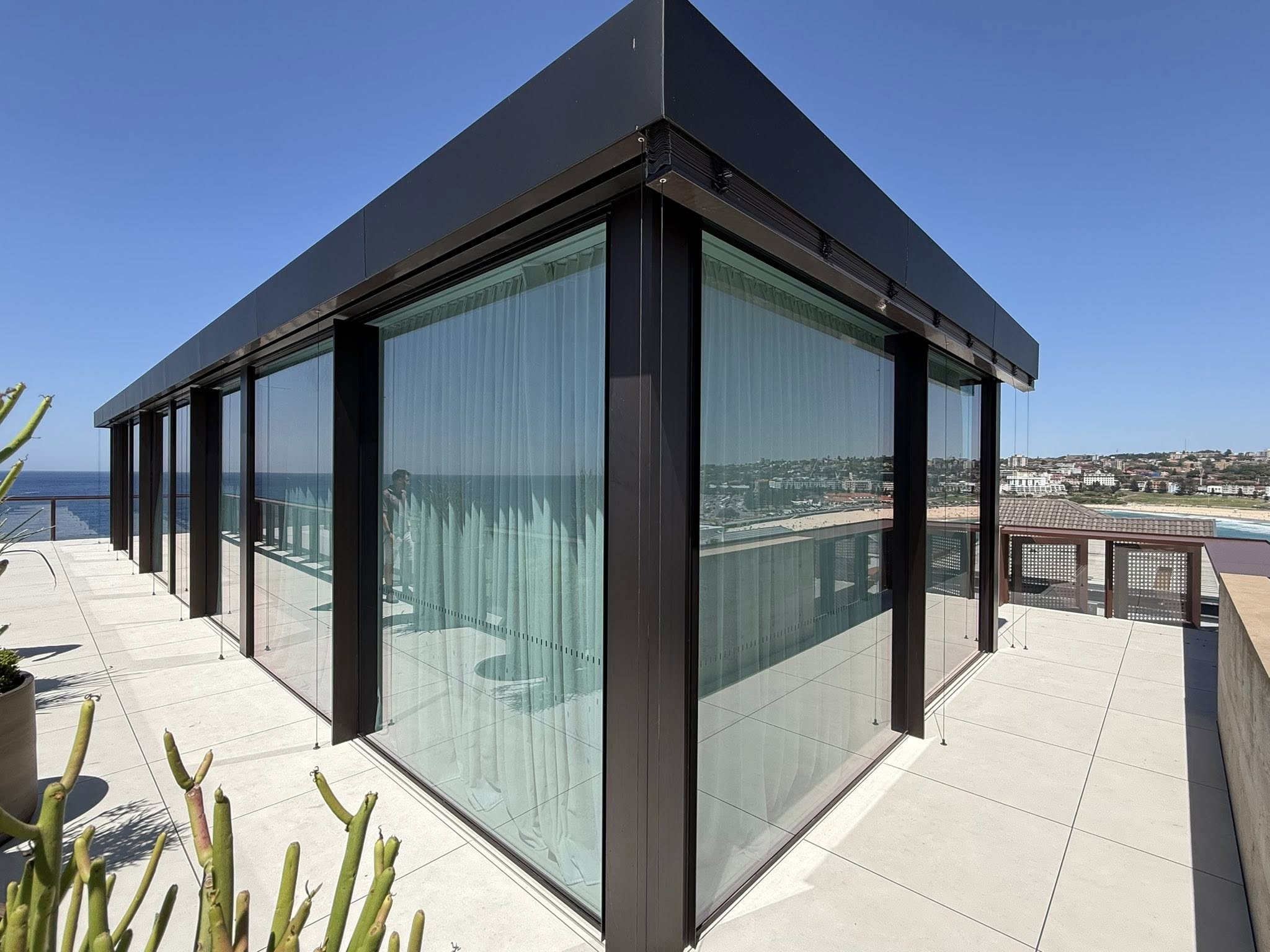
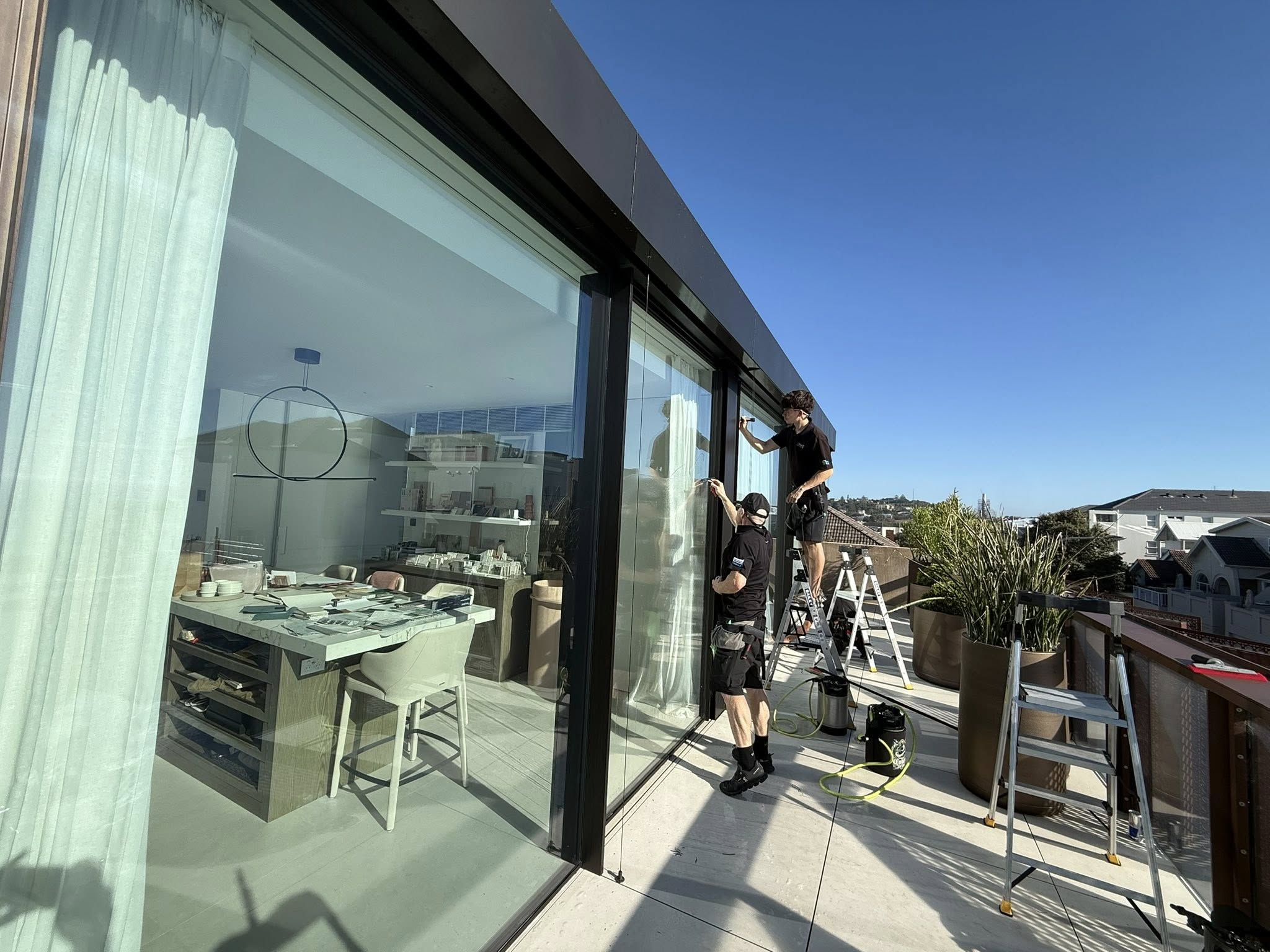
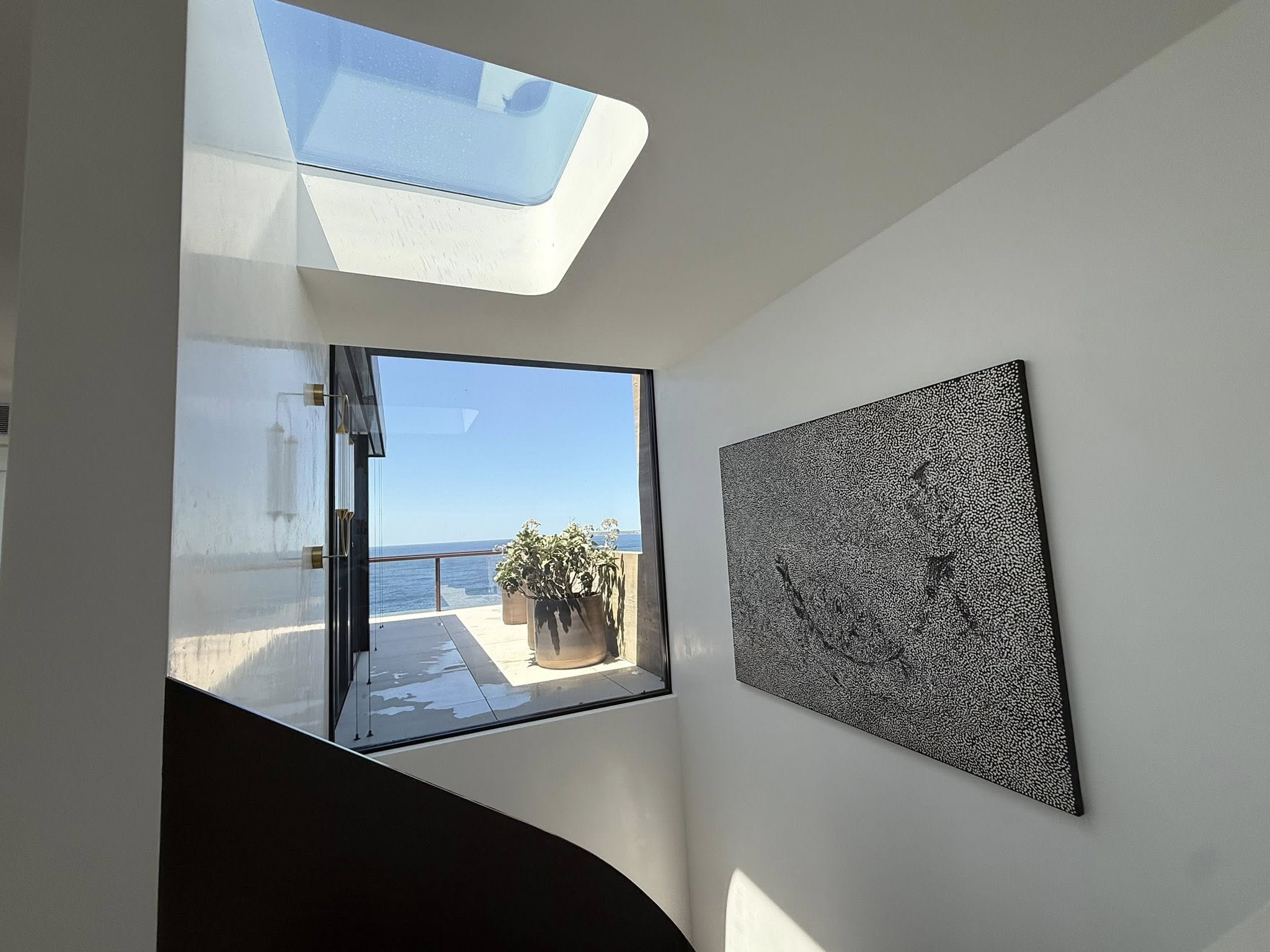
Pictured here is a multi-million dollar Bondi beach home with recently installed film. The top level has high performance windows in every direction, each with double glazing, a Low E coating (on surface two) and argon gas filler. The interior cooked in Summer.
To maximise heat reduction, an external film was installed.
WFAANZ stance on film and Low E glass: the application of film directly onto the coated surface is not advised.
In this case, the Low E coating was on surface two of an IGU, but for single pane it is not recommended to apply film to the actual coating. External films should be used in these scenarios.
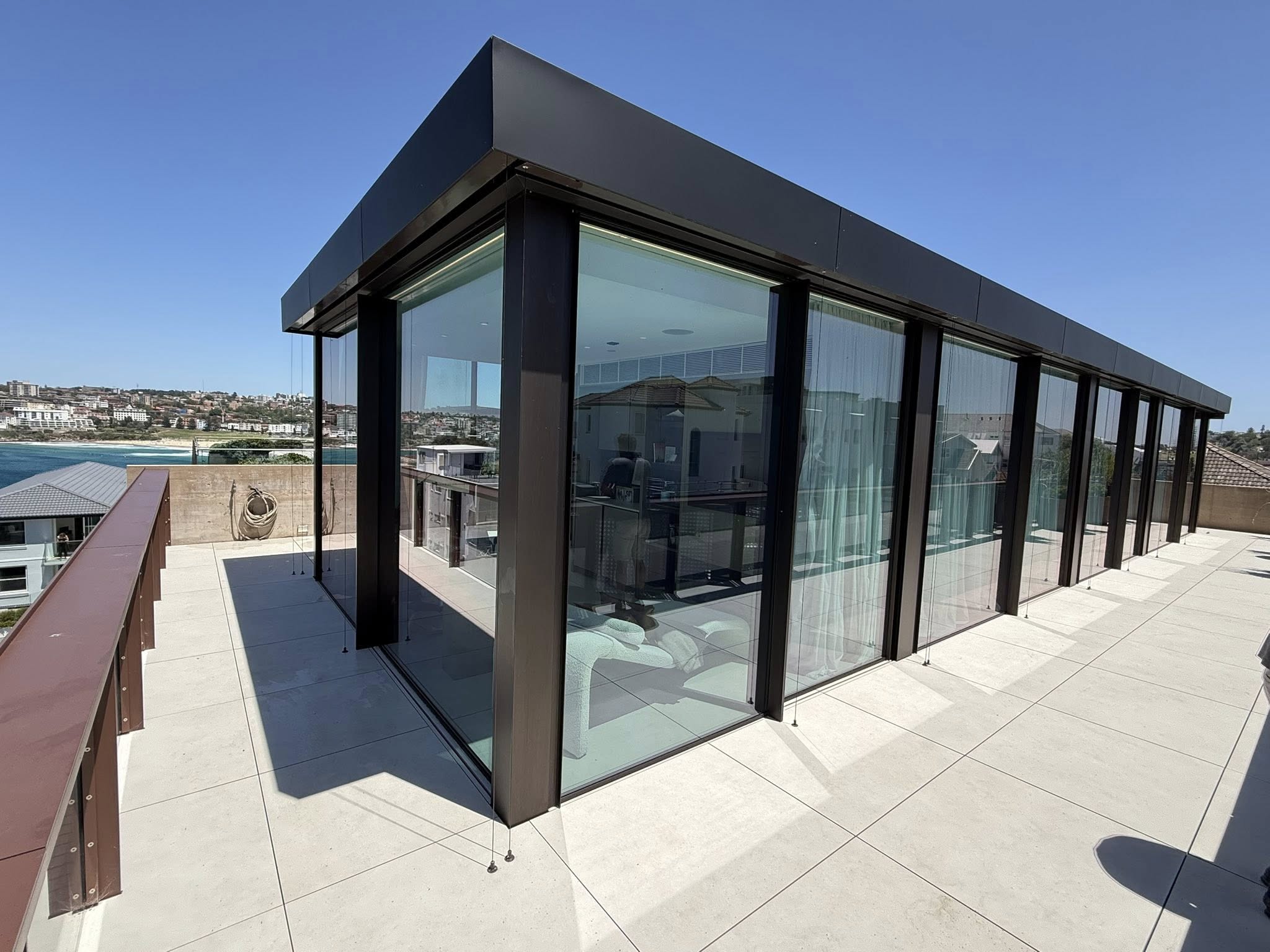
Ally warns, “While the Low E surface should face internally on single pane windows, it doesn’t always. And the coating facing the right way on one window doesn’t mean all windows in the building will follow suit. Check each one, it’s risky to assume they’ve each been fabricated and installed correctly.”
Anyone keen to sharpen their film matching knowledge should consider WFAANZ Architectural Window Film certification. Contact info@wfaanz.org.au for more info.
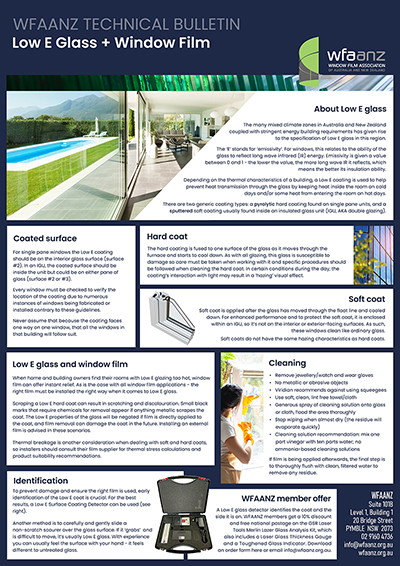
NEW Low E Glass technical bulletin
A new Low E glass information sheet has been produced for WFAANZ members. Designed to support you when explaining the considerations of installing window film onto Low E glass to your customers.
This is the second in our GLASS + FILM series, the toughened glass issue released last year and laminated glass next in line.
Members will be sent the PDF, which you can upload to your website, post on socials, print for referral when on site, add to your sales kit, send on request, etc.
Glass ID
Glass type, coatings, coating location and glass thickness should influence film recommendations and installation considerations. For accuracy and assurance, these glass analysis tools can be used:
- Low E glass detector
- Laser Glass Thickness Gauge
- Toughened Glass Indicator
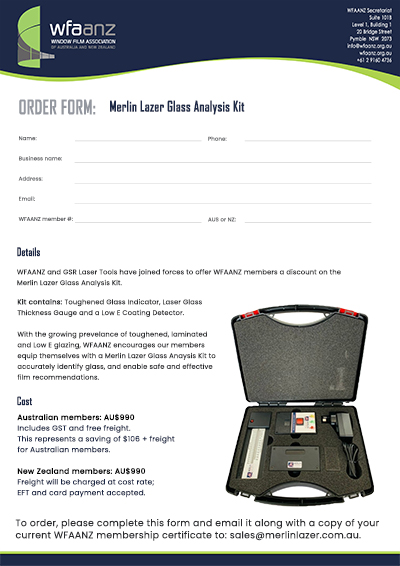
The Merlin Lazer Glass Analysis Kit contains these tools. WFAANZ and GSR Laser Tools have joined forces to offer our members a 10% discount and free Australian postage on the GSR Laser Tools Merlin Lazer Glass Analysis Kit.
Download an order form here or email info@wfaanz.org.au for more info.
Business software for tinters
Specialised business software packages for tint businesses claim to organise the different elements of running a tint business in one user-friendly, online format. Subscription based, tinters sign up to access the app that performs as a CRM (customer relationship management) system designed with tint businesses in mind.
Generally, they help streamline business activity such as*:
- Inventory
- Scheduling
- Quotation
- Proposals
- Customer database
- Project management
- Invoicing
- Accounting
- Employee earnings
- Payment processing
- Customer reminders and follow up
- Warranty registration
*The products are different, so each may not include all the above or some may be sold as extras.
Examples of these apps include Tint Wiz and Urable, both designed in the USA and available to Australian and New Zealand businesses. Both were recently purchased by software and payment technology development company Fullsteam (more info in this Window Film Mag article).
Newcomer to the market is Tint Edge, which was developed in Australia and identifies its lower price as a distinct point of difference to its competitors.
Michael Miller, Tint Edge, “I genuinely believe software will shape the future of our industry. It’s already influencing how we quote, schedule, communicate and deliver work today.”
Beyond the glass
The lifts in this 39-storey Melbourne commercial building were overdue for a refresh. As evidenced in the before picture (right), the finishes had taken a hit. Enter architectural window film.
Why not replace the doors? Film installer Chris Wingard, Alpine Tint, explains: “Once a lift has been certified, replacing the doors triggers recertification requirements, at a significant cost. An architectural film solution provided a far more efficient pathway, allowing the desired finish to be achieved without affecting compliance or introducing unnecessary complexity or costs.”
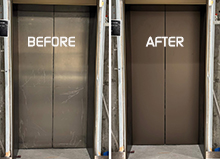
The product is a surface finish film that replicates materials like timber or metal, while providing high durability. This version also has enhanced abrasion resistance, making it well suited to high-traffic environments like lifts. The lift was operational during installation, but movements were coordinated while the work was carried out.
Minor inconvenience + less expense + durability + attractive finish = happy client.
Coming clean about windows with film, by Ally Cronan
A few years back I had film installed on my west-facing kitchen windows. On hot days, it used to be a choice between heat/glare or lovely valley views/natural lighting, so the window film was a game-changer.
The job looked amazing…for about three glorious hours until my husband came home, forgot about the install, used a scourer to ‘clean’ the glass and scratched the film.
As WFAANZ marketing director, the person who writes window film cleaning guides, am I embarrassed we didn’t follow the rules in my own home? Yes, I am. Embarrassment aside, it’s a point worth mentioning to your customer: everyone should know how to clean windows with film – partners, kids, tenants, cleaners, mothers in law, etc.
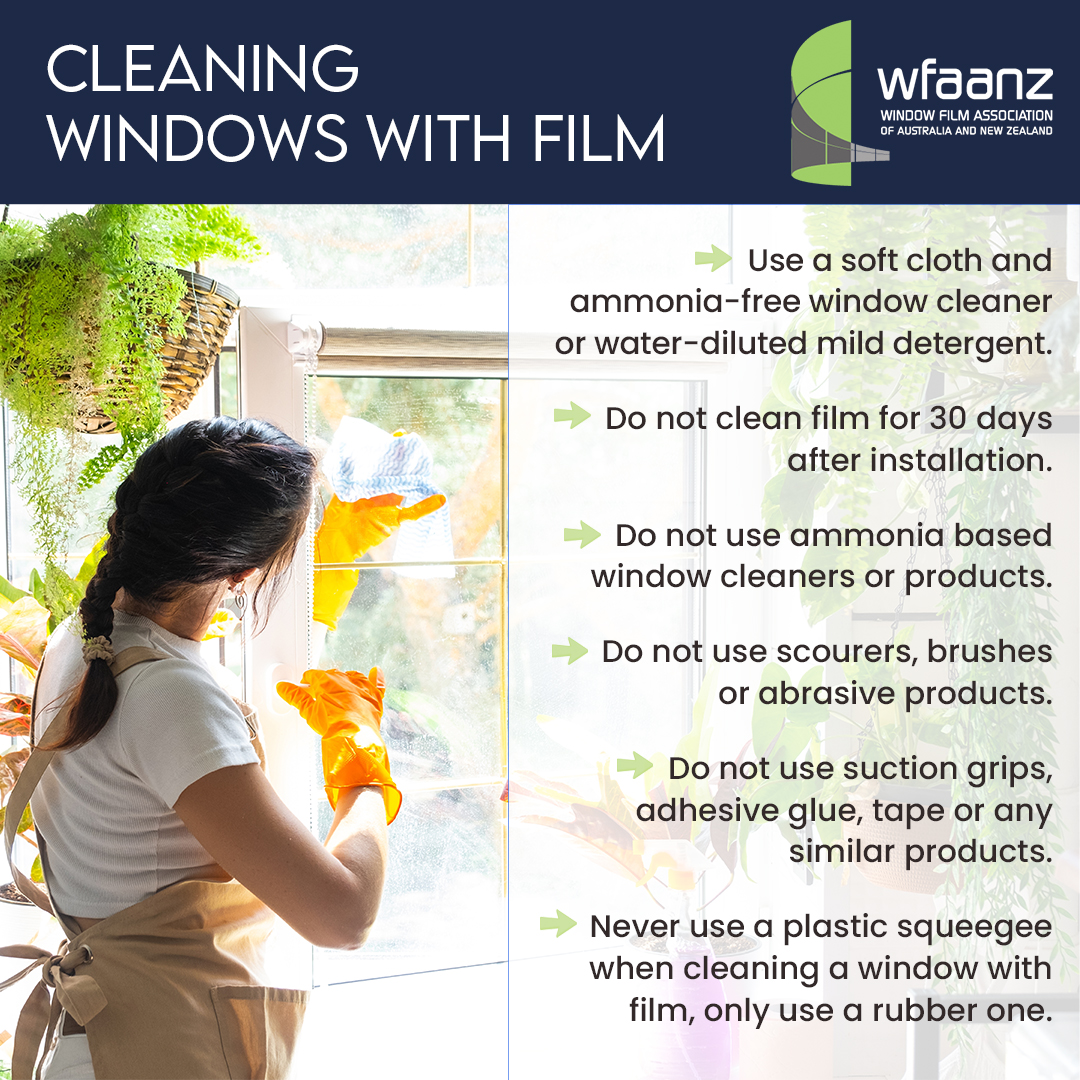
WFAANZ recently created this graphic with some advice on cleaning windows with film. We also have a fact sheet, which many of our members like to leave with their customers after the job is done.
For general window cleaning advice, read this Home Beautiful article that adopts a neat two-bucket approach.
First stop, tint shop
“A whole lot of truck for two tinted windows”, says WFAANZ member Dave Kazanowski Fraser Coast Tint of this brand new W900 SAR, limited edition Legend Series.
The new owner apparently picked the ripper up from Melbourne and dropped it in for a tint the same week.

Madico to acquire Johnson
On Jan 21, 2026 Madico, Inc. and Johnson Window Films, Inc. announced Madico’s acquisition of Johnson Laminating & Coating and Johnson Window Films.
Read more here.

Manifestations in buildings covered by the access and mobility standard
Amendments to the Disability (Access to Premises – Buildings) Standards 2010 are now in effect, including a reference to the 2021 edition of ‘AS 1428.1 Design for access and mobility’ – which tinters should be across as it covers manifestations. This may read like old news, after all, the Premises Standard is from 2010 and AS 1428.1 was updated in 2021 – but it wasn’t until mid-last year this was called up in the National Construction Code (NCC), with NCC 2022 Amendment 2 published on 29 July 2025. Manifestation requirements under this standard have not changed.

If you’re in this line of work, WFAANZ recommends buying the standard. More info about that process here.
Nod from the USA Department of Energy
The US Department Of Energy website states that window film is…”useful for homeowners who don’t want to block views with other window treatments, but who have issues with glare and solar heat gain. They can also be a good choice on windows that are difficult to fit with other window treatments, or in places where artwork, furniture, or carpeting could be faded by UV exposure.”
Read the full page here.

Cars24 recommends WFAANZ members
In an article covering all things window tint, cars24 connects the dots between ‘a good window tinting service’ and ‘WFAANZ membership’.
“Identifying a good car window tinting service in Australia involves verifying their business, ensuring high-quality materials, and confirming they adhere to strict national standards for safety and legality. Here are some key factors you should consider…WFAANZ membership: Look for members of the Window Film Association of Australia and New Zealand (WFAANZ) who must adhere to a strict code of ethics and changing state laws and product technologies.”
Download the membership registration form or call Helen at +612 9160 4736.
New Aussie super rules
From 1 July 2026, employers are required to deposit their employees’ super into accounts within seven business days of payday. The Australian Taxation Office refers to it as Payday Super.
A detailed fact sheet prepared by the Australian Chamber of Commerce and Industry is available here, with info like:
- Advice on deadlines
- Which workers/employees it applies to
- Repercussions of not paying on time
- Steps to follow before the 1 July 2026 start date

FEATURE
T&C health check
How long since you reviewed your Terms & Conditions (T&Cs)?
If the answer isn’t within the last 12 months, then it might be time. Not abiding by any one of the many requirements of legally binding T&Cs could leave your business exposed. Hiring a commercial contracts lawyer to review the document is recommended, to ensure all eventualities are covered.

Getting it right doesn’t just involve the wording and content. Location and accessibility is key (where/how the T&Cs are available), legibility considerations like font and font size, and the process – does the customer have to agree to them before you proceed with the job, how, is an additional waiver required for high-risk scenarios?
For a legal perspective, WFAANZ interviewed Belinda Marsh, Partner, Makinson d’Apice Lawyers, for general T&C advice for tint businesses:
What should be in your T&Cs?
T&Cs are what makes up a service contract. The same laws apply for T&Cs whether they’re in the form of a contract signed by parties, or a document attached to a purchase order or invoice.
T&Cs are the core provisions of any written agreement between your business and the people or companies that provide you with goods or services. They may be in the form of a document you give to customers as part of an invoice or purchaser order, or a formal service contract that the parties sign before services are provided.
Getting the basics right from the start can save you a great deal of trouble down the track. Every solid set of T&Cs should clearly spell out what is being supplied, when it will be delivered, how much it costs, and what happens if things go wrong. Think about including terms around payment timelines, quality standards, how either party can end the agreement, and what happens if one side does not hold up their end of the deal. We recommend your contract documents and T&Cs be written in plain language, so that all parties knows where they stand before a service is confirmed.
What are the rules for ensuring T&Cs are fair?
If your business deals with small businesses or individual consumers using standard-form contracts (which includes standard T&Cs provided to customers) there are important rules under the Australian Consumer Law that you need to be aware of.
The law protects people from “unfair contract terms”, which are clauses that create a significant imbalance between the parties, are not reasonably necessary to protect a legitimate business interest, and would cause real harm if they were enforced. Common examples include terms that let one party change the contract at will without telling the other, terms that allow only one side to end the agreement, or penalty clauses that are wildly out of proportion to any actual loss. These kinds of terms can be declared void (meaning a court can treat them as if they never existed) which may leave your business exposed. We recommend you review your T&Cs and make sure every clause has a genuine, proportionate purpose that both sides can understand.
Is misleading conduct a factor when writing T&Cs?
One of the most important rules under the Australian Consumer Law is the ban on misleading or deceptive conduct. It applies to almost everything your business communicates, from advertisements and product descriptions to verbal promises made during a sales conversation.
The key principle is simple: do not create a false impression in someone’s mind, even if you do not mean to. You do not need to intend to mislead someone for your conduct to be unlawful, if a reasonable person could be led to a wrong conclusion based on what you said, wrote, or advertised, that can be enough to get your business into trouble.
This covers exaggerating a product’s features, making promises you cannot keep, leaving out important information, or using fine print to contradict something you said upfront. We recommend that not only should you make honest, accurate and complete representations of your business’s goods and services, your T&Cs should reflect what has been communicated to third parties.
Makinson d’Apice Lawyers has agreed to offer WFAANZ members a 10% discount on a T&C review. There is no set fee for this work, as it entirely depends on the document under review. Makinson d’Apice Lawyers will provide a quote, and apply a 10% discount for WFAANZ members. If interested, please contact Ally Cronan, ally@acpublicrelations.com.au.
We have had an issue with thermal cracking on a tinted window. The customer verbally agreed to the thermal break risk on a double-glazed unit but then stated consumer law requires it to be in writing. Just wondering if you have a statement that we could include on quotes etc to preclude the problem we now have.
While instances of thermal breakage are rare, it is a risk the tinter must acknowledge. When the windows in question are double glazed, Low E coated, laminated, thickened glass, large panes, etc., installers should create a ‘paper trail’ proving their transparency on the subject of thermal breakage. That way, there is little leeway for the client to claim they weren’t informed.
This could take a variety of different forms – sighted/sent T&Cs, signed waiver, an acknowledged email with a fact sheet explaining the risks attached, etc. WFAANZ recommends a contracts lawyer be hired to review both your T&Cs and your procedures to ensure you’re covered (see above article).
NB: In-depth training on thermal breakage susceptibility is provided in the WFAANZ Architectural Window Film Certification program.
Some businesses in Queensland, including certain car dealerships, are offering windscreen tinting for sale. Does this mean that tinting the front windscreen is now legal?
No, it is not legal for car owners to apply film to the main area of a passenger vehicle’s front windscreen in Queensland, or anywhere else in Australia or New Zealand.
Selling windscreen film itself is not illegal because there are certain vehicle types and limited applications where film may be permitted. It is the responsibility of the installer to understand and follow the regulations, and to advise customers accordingly so that vehicles remain compliant with the law.
I’m looking for an external safety film that is compliant with AS2208, can WFAANZ recommend any products?
We can’t recommend suitable products for two reasons. Firstly, no external safety films are AS2208 compliant as the standard only covers safety films installed internally. Secondly, WFAANZ does not recommend specific products as we closely protect our independence. We can advise that WFAANZ distributor members, listed here, actively support the industry and commit to abiding by all Australian and New Zealand regulations and requirements.
Welcome new members Monarch Coatings, VIC Mid Coast Tinting, NSW Geographe Window Tinting, WA Dark Side of The Film, VIC Getinted, VIC

Training news
We will be holding an Architectural Window Film online workshop in the coming months, date TBC. You should join us if you’re interested in honing your skills, you’ve got staff you’d like trained or want credentials to help secure that next big commercial or residential job. Please email Helen at info@wfaanz.org.au for more info or visit our training page.
Behind the scenes, we’re planning some major changes for the way the WFAANZ certification training workshops are delivered and managed – stay tuned on that front.

A line in the sand in New Zealand
The growing prevalence of window film installers without experience or skills, incorrectly applying inferior films onto the wrong glass, is cause for concern for New Zealand installers who still think standards, quality, customer satisfaction, regulations and reputation matter.
If left unchecked, the situation could damage the industry. Now more than ever, a strong industry association set on upholding standards and promoting a code of conduct is critical if we are to turn this crisis into an opportunity.
This is a chance to draw a line in the sand between the posers and serious tinters. A chance for the industry to redefine itself.
The WFAANZ mission is to give everyone – end users, tradies, building owners, dealerships, government officials, etc. – assurance of our industry’s support of quality products tested for this region, and its commitment to compliance, standards, training and development.

As a WFAANZ member you can…
- set your business apart from competitors,
- access materials and updates to help you generate sales,
- make it harder for cowboys to operate unchecked, and
- support the industry that supports you.
WFAANZ is calling on New Zealand film installers and distributors to band together under the WFAANZ banner to present a united front. Join now, and your membership will last till the start of the 2027 financial year.
Download the New Zealand fact sheet, membership registration form, visit the website, or contact Helen at info@wfaanz.org.au.
Laying down logo laws
To the NZ and Aussie tinters misusing the WFAANZ logo: this one is for you…
The WFAANZ logo means something. A business with the authority to use it has paid its dues, is serious about industry standards, commits to regulation compliance and puts its money where its mouth is to safeguard and grow the market. As film installation is an unlicensed industry, WFAANZ membership is a source of assurance for customers. That’s why misuse of the logo is such a problem.

Using the WFAANZ logo without current membership status is an insult to the hundreds of tinters who have done the right thing. By misleading customers, it breaches consumer law and is a trademark infringement, both of which attract legal exposure.
To protect our members and brand, WFAANZ is clamping down on logo misuse. Any business without current, financial membership status must either join WFAANZ immediately or remove the logo and any promotion of membership from websites, socials, materials, signage, signatures, etc.
If you’re using the logo it means you recognise its value – and if you see its value, you should be a legitimate member.
A WFAANZ logo licence agreement is incorporated into the membership registration form, which all new members must sign. If anyone has questions, please email Helen at info@wfaanz.org.au.
Intelligence or negligence…the perils of AI
Is ChatGPT trustworthy? For the answer, we asked ChatGPT (irony intended): “Tools like ChatGPT are trained to generate plausible-sounding text based on patterns in data, not to retrieve verified, citable facts. While they can be powerful assistants, they don’t check their work and they definitely don’t know what’s real and what’s not.”
This recent experience of WFAANZ proves the point…

AS 1428.1-2021 came into effect on 29 July 2025 with the publishing of the National Construction Code (NCC) 2022 Amendment 2. NB: Where NCC requires access for people with disabilities, the requirements for manifestation (visibility strips) are detailed in AS 1428.1.
Let me say upfront, the rules tinters should know about relating to manifestation requirements have not changed. ChatGPT did not think so though.
When prompted in early February it initially said two visibility strips are now required under AS 1428.1-2021 and stated that is a change from the 2009 publication that only required one. One week later, using the same prompt, ChatGPT said one strip is required under AS 1428.1-2021 and that is a change from the 2009 publication that required two. Both these ChatGPT answers are incorrect.
The 2009 and the 2021 publications are the same in terms of manifestations/visibility strips:
- One strip
- At least 75mm wide
- 30% luminous contrast
- The lower edge of the contrasting line between 900 mm and 1000 mm above finished floor level
The reason for ChatGPT’s conflicting and changing advice? It’s one and only source was a blog post from an association (not WFAANZ) that contained false information. The blog has since been taken down.
While ChatGPT answers may sound confident, detailed and authoritative, they can be factually incorrect. Be mindful it’s answers may contain:
- Fabricated court cases or legal precedents
- Non-existent legislation, clauses or standards
- Incorrect citations or references
- Made-up statistics or research findings
- Outdated regulatory information
- Incorrect interpretations of technical standards
For ChatGPT answers to be 100% accurate, every piece of information on the internet would need to be 100% accurate. That’s why verification is crucial – especially on health, legal, financial and safety matters, critical business decisions, or when researching how to comply with AS 1428.1-2021.